A custom video game brand activation is a set of games designed around a brand, its characters and its art, built for a specific event and played on site. It is not a sponsored logo on someone else's game or a tablet running a stock trivia app. Guests play something that only exists in that room, starring the brand's world, and the brand gets the thing activations rarely earn: people choosing to stay.
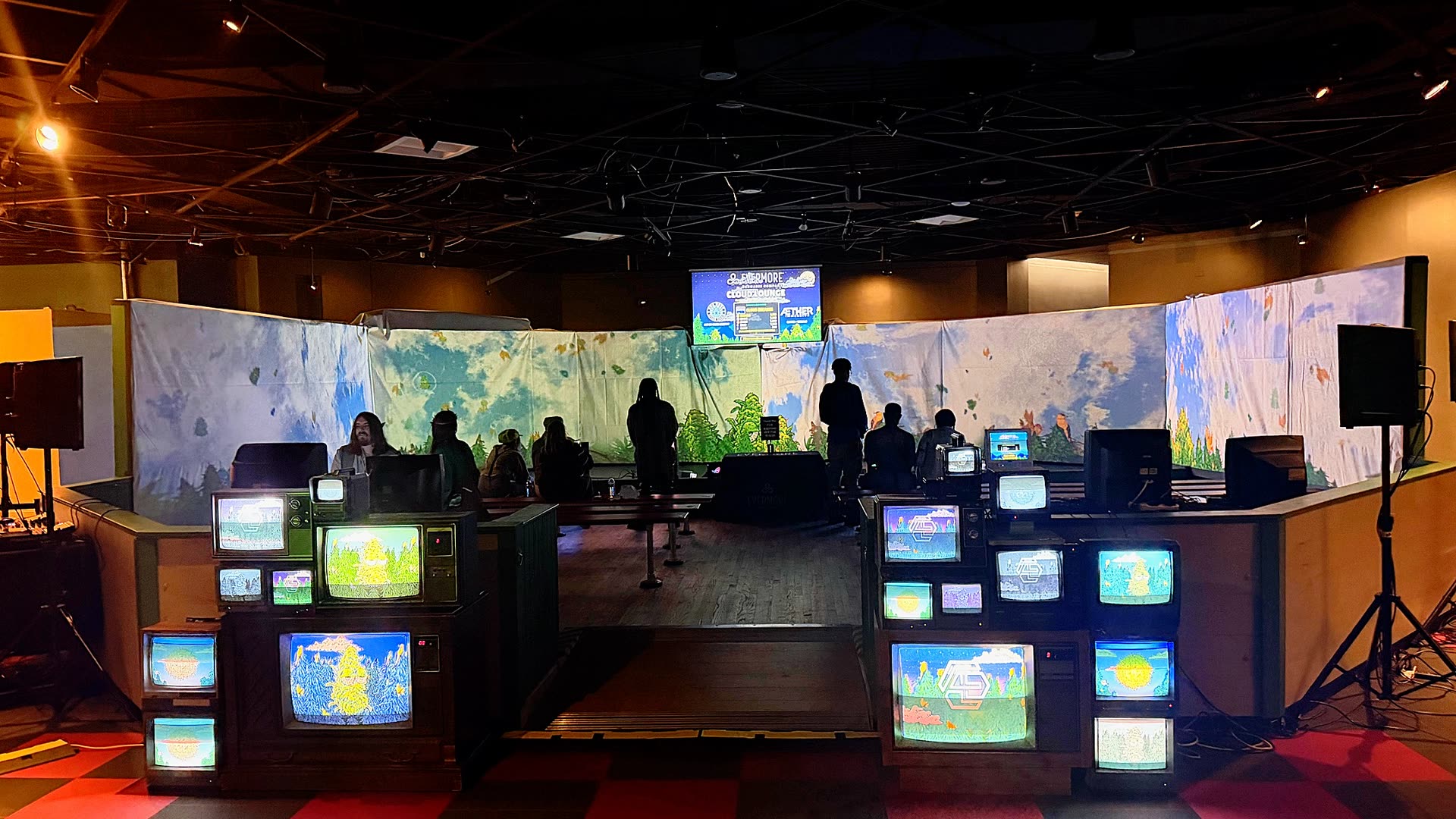
We built ten of them for the Evermore Cloud Lounge, an immersive lounge presented by Evermore Cannabis Company at Halloween at the Maryland Science Center in Baltimore on October 24, 2026. Every character came from Owen Murphy of One Drop Design Studio, every game played two at a time on vintage CRT televisions, and every score went live to a sign above the stage. Guests played 1,362 games over the night, 504 of them head to head. This post covers what made that work and what to plan for if you want an arcade of your own.
Why a branded arcade beats most activation formats
Most brand activations are built to be passed through: a photo wall, a sample table, a screen looping a reel. They compete for a few seconds of attention and lose most of it to the phone in the guest's hand. Games invert that. A guest who picks up a controller has decided to spend the next minute with your brand, and a good game makes them want to spend the minute after that too.
- Dwell time is the product. A round of a short arcade game runs under a minute, and people play several. At the Cloud Lounge the average game lasted 45 seconds.
- Competition pulls in an audience. A two-player game is a show for whoever is waiting, and a leaderboard turns strangers into rivals.
- The brand is the world, not a banner. When the characters, colors and jokes are the brand's own, every minute of play is brand exposure nobody skips.
- It produces data honestly. Scores, play counts and sign-ups come from people who chose to play, not from a form someone was handed at the door.
Designing branded games people actually play
The single most important decision is how long a game lasts. Event games are not living-room games. Nobody reads a tutorial at a party, and nobody will hold a station for ten minutes while a line forms. We designed every Cloud Arcade game to be understood in five seconds and over in about a minute, using genres guests already know in their hands: a flappy hopper, a catcher, a falling-piece puzzle, a brick breaker, a side-scrolling shooter.
- Five-second rule
- If a guest cannot tell what to do within five seconds of the title screen, the game will be abandoned at a busy event. Familiar mechanics with the brand's art on top beat novel mechanics every time.
- Attract mode
- The demo a cabinet plays when nobody is at it. It is the activation's advertising: it shows the game being played and pulls people over. Every Cloud Arcade station cycled through demos of its games when idle.
- Head-to-head
- Two players on one screen at once. It doubles throughput per station, gives the line something to watch, and makes the game social rather than solitary.
- Live leaderboard
- A shared high-score table, updated as scores land, shown somewhere everyone can see it. It is what turns a room of separate games into one competition.
Every game in the Cloud Arcade plays head to head, and that was the right call: 504 of the night's 1,362 games were two-player matches. Two players at one screen is also a crowd magnet, because the people waiting are watching a match instead of staring at someone's back.
The brand lives in the art, not the logo
The fastest way to make a branded game feel cheap is to stamp a logo on a generic template. The Cloud Arcade worked because the games were built out of Owen Murphy's drawings: his clouds, his creatures, his mountains and his three nug characters, Nuglas, Herbert and Buddy. Guests were not looking at an ad for the world, they were playing inside it. The brand mark appears where a real arcade would put it, on the title screen, the pause and game-over panels and the occasional bonus pickup, and the art does the rest.
Hardware: why vintage TVs and small computers
Screens are part of the design, not just a display. The Cloud Arcade ran on stacks of vintage CRT televisions, which do two things a flat panel cannot: they read as an arcade from across a dark room, and they make the installation feel like a place rather than a row of monitors. The TVs came from Smooth Canoe; we built the games at 640 by 480 for their 4:3 picture tubes and kept all text inside a safe margin because old sets crop the edges of the image.
Each station is a Raspberry Pi running the games in a locked-down kiosk, written in JavaScript. Small computers keep each station cheap, replaceable and quiet, but they demand discipline: the games are written to run smoothly on modest hardware, every station boots straight into the arcade, and nothing depends on a person being there to restart it. We cover the general principles of unattended hardware in building kiosks that last, and the tradeoffs of web-based versus engine-based builds in WebGL vs Unity vs Unreal for installations.
| Decision | What we chose | Why it matters at an event |
|---|---|---|
| Round length | About a minute | Keeps the line moving and lets a guest play again |
| Players | Two per station, every game | Doubles throughput and gives the line a show |
| Screens | Vintage CRT TVs | Reads as an arcade across a dark room; part of the set |
| Computers | Raspberry Pi kiosks | Cheap, swappable, boot straight into the games |
| Network | Private router, no internet | Scores share locally; nothing depends on venue Wi-Fi |
| Failure mode | Local board, sync later | A dropped connection never stops play |
The leaderboard is the activation
The part of the Cloud Arcade that did the most work for the brand was not a game. It was the sign. Every station sent its scores to a shared server, and a screen above the stage showed tonight's top scores for each game, rotating through all ten and throwing up a banner whenever someone set a new record. A high score in a corner of the room was on the big screen seconds later, with the player's name on it.
That visibility is what turns play into marketing. Evermore entered the top score in each game into a prize raffle, and when a guest set a high score, the TV asked for an email so they could hear if they won and join Evermore's list. About a quarter of the high scorers who were asked left one. It is an honest exchange: the guest gets a shot at a prize and their name in lights, and the brand gets a contact who has already spent time inside its world.
A sign-up form at the door asks for something before giving anything. A high-score screen asks after the guest has already won.
Build the leaderboard to survive real conditions. Ours runs on a private router with no internet, keeps tonight's scores separate from test scores and past nights, filters names so nothing offensive goes up on the big screen, and lets staff fix or remove an entry from a phone. When a station loses the network it keeps playing on its own board and catches up when the connection returns.
Planning a custom game activation
- Start from the brand's world. Characters, art and a few in-jokes are worth more than any feature. If the brand has an artist, build around their work.
- Pick genres guests already know. Novelty belongs in the art and the setting, not in the controls.
- Make it competitive and visible. Two players per screen and a leaderboard everyone can see.
- Decide what a score is worth before you build. A raffle, a prize, a coupon or a mailing list gives the leaderboard a purpose and the brand a measurable result.
- Check the rules for your category early. Regulated brands have marketing and age requirements that shape copy on every screen, so build them in from the first draft.
- Plan for nobody watching. Stations must boot, recover and keep playing without staff.
Frequently asked questions
What is a custom video game brand activation?
It is a set of games designed around a brand's own characters, art and story, built for a specific event and played on site. Unlike a sponsored placement in an existing game, the whole world belongs to the brand, so every minute of play is brand exposure guests choose for themselves.
How long should a game be at a brand activation?
About a minute per round. Event guests will not read instructions or hold a station while a line builds. At the Evermore Cloud Lounge the average game lasted 45 seconds across 1,362 games played in one night.
How do branded games capture leads?
Through the leaderboard. When a guest sets a high score, ask for an email so they can hear if they won a prize. The guest has already engaged and won something, so the ask feels earned. At the Cloud Lounge about a quarter of high scorers who were asked left an email.
Can the games run without internet at the venue?
Yes, and they should. Run the stations and the leaderboard on your own private network so nothing depends on venue Wi-Fi, and have each station keep a local scoreboard that syncs when the connection returns.
What hardware do you need for a custom arcade?
A screen, a small computer and a controller per station, plus one machine running the shared leaderboard and sign. We use Raspberry Pi kiosks with classic two-button pads, and chose vintage CRT TVs for the Cloud Lounge because they read as an arcade and double as set design.
For scoping one, see branded games and arcades. Custom games sit where our software development and interactive kiosk work meet. The Evermore Cloud Lounge case study shows the full room, including the projected sky the arcade sat inside, and how projection mapping reshaped live events covers the visual side of the same kind of activation.